Food & safety
Are coloured chopping boards a thing of the past?


Traditionally, coloured chopping boards have been used in commercial kitchens to support good food safety processes. The theory, in brief, is that keeping specific boards for specific foods reduces the risk of cross contamination. But does the theory stand up in practice?
The principle behind coloured chopping boards is that foods that are likely to carry pathogenic bacteria are kept away from those that don't. Raw meats and fish are high risk food. They may carry low levels of bacteria even before they enter your kitchen, so it is important that any surface and utensils you use for these foods are cleaned and disinfected BEFORE they are used for other foods. This is where a coloured chopping board can be useful, as low risk foods can be prepared on boards that have been kept specifically for that purpose. But this only works if everyone understands the same colour code - and thorough cleaning and disinfection is still vital in between uses.
Cooked meats, cheeses and ready to eat chilled foods are also high risk foods. They are high in protein and moisture and an ideal breeding ground for bacteria in the wrong conditions. Traditionally, cooked meats would be chopped on yellow boards, and cheese on a white board, alongside bakery - but here is another flaw in the process; if not kept safely, cheese may contain bacteria such as Listeria monocytogenes, Staphylococcus aureus, Escherichia coli, or Salmonella enterica, therefore using an unwashed chopping board for both bread and cheese runs a considerable risk of cross contamination.
We've established that coloured boards can be a useful tool alongside proper cleaning and disinfection. But, much like plastic gloves, boards can provide a false sense of security, and lazy cleaning practice can creep into kitchens if coloured boards are seen as the ultimate preventative measure against cross contamination. And it only takes one food handler to forget the colour code for the whole system to fail disastrously.
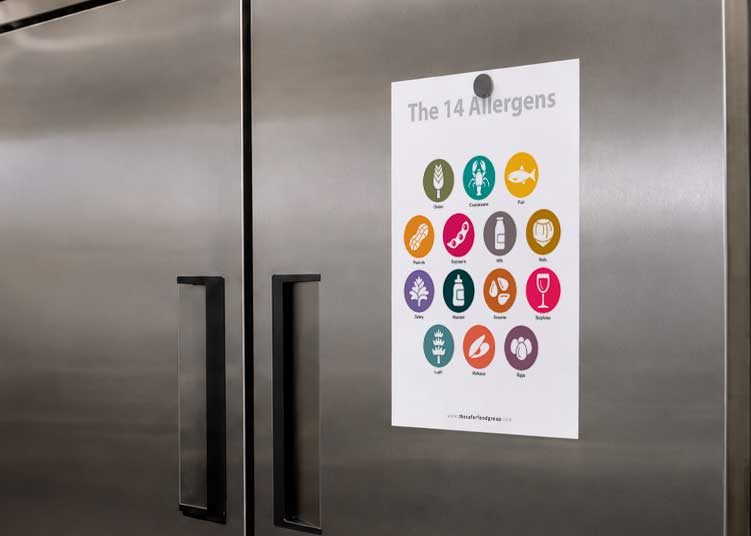
A relatively new addition to the world of coloured chopping boards is the purple board, for allergens. Again, this is a really tricky area. Using a separate board for allergenic ingredients can help ensure that they don't find their way into 'allergen free' dishes - but it doesn't guarantee that traces of one allergen doesn't contaminate dishes containing a different stated allergen. And don't forget that some allergens can become airborne - a purple chopping board is not an effective safeguard against peanut dust circulating throughout your kitchen.
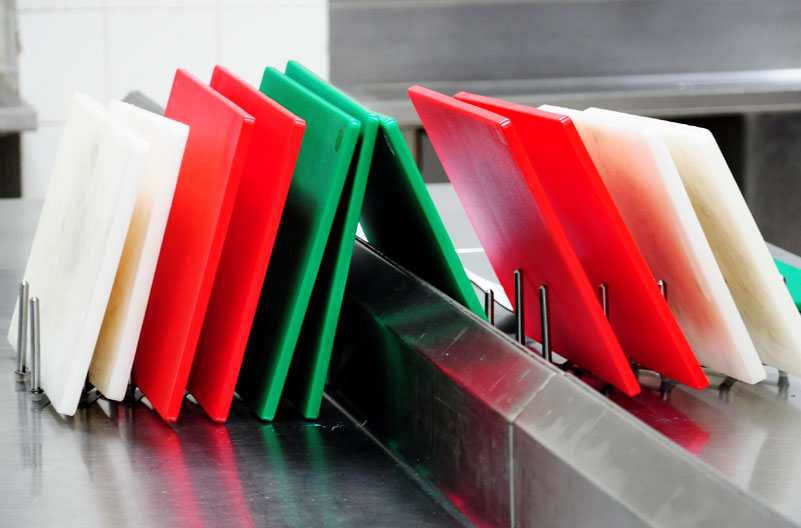
So, used correctly, coloured chopping boards can be a useful tool. But how do you store them in your kitchen? Often, chopping boards are stacked in cupboards on top of each other. Whilst this is the most stable method of storage, it also means that surfaces are touching each other, and any residual particles can spread from board to board. Stacking side on, in a rack that keeps each board separate eliminates contamination from one board to another.
The quality of your chopping boards is also very important. Flimsy plastics may warp and score easily, enabling pathogens to build up within cut marks. Flimsy plastics also run the risk of becoming damaged and releasing microplastics into foods and waste water. Porous materials can also harbour pathogens as liquids from foods are absorbed into the board.
High-density, food-safe polyethylene (HDPE) or polypropylene (PP) are suitable materials for chopping boards, but these do need to be inspected regularly for damage and replaced as soon as they show signs of wear.
In summary, coloured chopping boards can be an extra safeguard against cross contamination, as long as your system is understood and followed by every member of your kitchen team. But be careful they don't lead to complacent working practices or a replacement for thorough washing and disinfection between uses.
Need more information about introducing safe practices into your kitchen? Have a look at our Level 2 Food Hygiene, Level 2 HACCP and Level 3 Food Safety (Supervisors) courses today.
Traditionally, coloured chopping boards have been used in commercial kitchens to support good food safety processes. The theory, in brief, is that keeping specific boards for specific foods reduces the risk of cross contamination. But does the theory stand up in practice?
The principle behind coloured chopping boards is that foods that are likely to carry pathogenic bacteria are kept away from those that don't. Raw meats and fish are high risk food. They may carry low levels of bacteria even before they enter your kitchen, so it is important that any surface and utensils you use for these foods are cleaned and disinfected BEFORE they are used for other foods. This is where a coloured chopping board can be useful, as low risk foods can be prepared on boards that have been kept specifically for that purpose. But this only works if everyone understands the same colour code - and thorough cleaning and disinfection is still vital in between uses.
Cooked meats, cheeses and ready to eat chilled foods are also high risk foods. They are high in protein and moisture and an ideal breeding ground for bacteria in the wrong conditions. Traditionally, cooked meats would be chopped on yellow boards, and cheese on a white board, alongside bakery - but here is another flaw in the process; if not kept safely, cheese may contain bacteria such as Listeria monocytogenes, Staphylococcus aureus, Escherichia coli, or Salmonella enterica, therefore using an unwashed chopping board for both bread and cheese runs a considerable risk of cross contamination.
We've established that coloured boards can be a useful tool alongside proper cleaning and disinfection. But, much like plastic gloves, boards can provide a false sense of security, and lazy cleaning practice can creep into kitchens if coloured boards are seen as the ultimate preventative measure against cross contamination. And it only takes one food handler to forget the colour code for the whole system to fail disastrously.
A relatively new addition to the world of coloured chopping boards is the purple board, for allergens. Again, this is a really tricky area. Using a separate board for allergenic ingredients can help ensure that they don't find their way into 'allergen free' dishes - but it doesn't guarantee that traces of one allergen doesn't contaminate dishes containing a different stated allergen. And don't forget that some allergens can become airborne - a purple chopping board is not an effective safeguard against peanut dust circulating throughout your kitchen.
So, used correctly, coloured chopping boards can be a useful tool. But how do you store them in your kitchen? Often, chopping boards are stacked in cupboards on top of each other. Whilst this is the most stable method of storage, it also means that surfaces are touching each other, and any residual particles can spread from board to board. Stacking side on, in a rack that keeps each board separate eliminates contamination from one board to another.
The quality of your chopping boards is also very important. Flimsy plastics may warp and score easily, enabling pathogens to build up within cut marks. Flimsy plastics also run the risk of becoming damaged and releasing microplastics into foods and waste water. Porous materials can also harbour pathogens as liquids from foods are absorbed into the board.
High-density, food-safe polyethylene (HDPE) or polypropylene (PP) are suitable materials for chopping boards, but these do need to be inspected regularly for damage and replaced as soon as they show signs of wear.
In summary, coloured chopping boards can be an extra safeguard against cross contamination, as long as your system is understood and followed by every member of your kitchen team. But be careful they don't lead to complacent working practices or a replacement for thorough washing and disinfection between uses.
Need more information about introducing safe practices into your kitchen? Have a look at our Level 2 Food Hygiene, Level 2 HACCP and Level 3 Food Safety (Supervisors) courses today.
Join 950,000+ learners
Explore our award winning online video based training

The Safer Food Group
Unit 2, Integrity House,
Lower Lumsdale, Matlock
DE4 5EX

Back
to top
© The Safer Food Group 2026 | Privacy policy