Food & safety
What temperature kills bacteria in foods? A complete temperature control guide


Maintaining correct temperatures throughout the food preparation journey is vital to ensuring food safety. Knowing what temperature kills bacteria in foods is only part of the solution; you also need to control temperatures at every stage to reduce bacteria to a safe level and stop toxins from developing.
This guide explores what happens to bacteria at different temperatures, the official UK cooking and reheating standards, and how to manage temperature control safely from goods inwards to service.
2.4 million cases of foodborne illness occur in the UK each year, according to the Food Standards Agency (FSA).
8°C to 63°C is the danger zone where pathogenic bacteria multiply most rapidly.
£11.8 billion is the estimated annual cost of foodborne disease to the UK economy and society.
If you are wondering what temperature kills bacteria in food, the answer depends on the combination of heat and time.
Does heat kill bacteria? Yes, high temperatures destroy the cell structures of pathogenic bacteria. However, at what temperature is bacteria killed effectively?
In England, Wales, and Northern Ireland, the core standard for cooking high-risk food is reaching 70°C for at least 2 minutes. In Scotland, Food Standards Scotland (FSS) guidance recommends reaching a core temperature of 75°C for 30 seconds.
To kill bacteria effectively and reduce bacteria to a safe level, you can use any of these approved time and temperature combinations at the core of the food:
Does cooking food kill bacteria? Yes, thorough cooking to the required temperatures destroys live, vegetative bacteria. However, cooking does not guarantee complete food safety if temperature control has been neglected.
There is a critical exception to these rules: some types of bacteria produce spores and toxins when food is left in optimum temperature conditions for pathogenic growth.
Heat-Resistant Toxins: Certain bacteria release poisonous toxins as they multiply. Even if high heat kills the live bacteria during cooking, these chemical toxins cannot be denatured by heat and remain in the food, causing severe food poisoning.
Bacterial Spores: Some bacteria form protective shell-like spores that survive extreme cooking temperatures. Once the food cools back down into the danger zone, these spores germinate and begin multiplying again.
This underlines the vital importance of restricting the time high-risk food spends in the danger zone (8°C to 63°C) at every stage of preparation, storage, and service.
Understanding what happens to bacteria when you freeze the food is critical for safe food storage.
Many people ask: can bacteria grow in a freezer? The simple answer is no.
When food is frozen at -18°C or colder, pathogenic bacteria do not die; instead, they become dormant. Freezing stops bacterial multiplication, but it does not destroy the bacteria.
Does thawed food contain bacteria? Yes. As soon as food defrosts and enters warmer temperatures, dormant bacteria awaken and begin multiplying again.
Key defrosting rules include:
Defrost foods inside a chiller below 8°C or using a microwave.
Place thawing raw meat on the lowest shelf of the fridge in a sealed container so juices cannot drip onto ready-to-eat foods.
Never defrost poultry under running water or in a sink due to cross-contamination risks from splashing water.
Never refreeze food once it has begun to defrost.
Managing temperature for a few minutes is not enough; food businesses must control temperatures at every single stage of handling.
Raw dairy, meat, poultry, fish, seafood, and ready-to-eat chilled products must be checked immediately upon arrival.
When asking what is the best way to kill bacteria in food during reheating, consistency is key.
Chilled high-risk food can be displayed outside refrigeration at ambient temperatures for a single period of up to 4 hours. After 4 hours, any remaining food must either be placed back in the chiller or thrown away.
Bacteria are not killed instantly by a specific temperature, as destruction relies on a combination of heat and time. Higher temperatures require shorter times. For example, reaching a core temperature of 80°C kills bacteria in 6 seconds, whereas 60°C requires 45 minutes.
Does cooking kill bacteria? Yes, thorough cooking to recommended temperatures destroys live bacteria. However, if food has spent too long in the danger zone, some bacteria produce heat-resistant spores and toxins that cannot be denatured by heat. This is why cooking spoiled or temperature-abused food will not make it safe to eat.
No, bacteria cannot grow in a freezer operating at -18°C or colder. The low temperature forces bacteria into a dormant state, but it does not kill them.
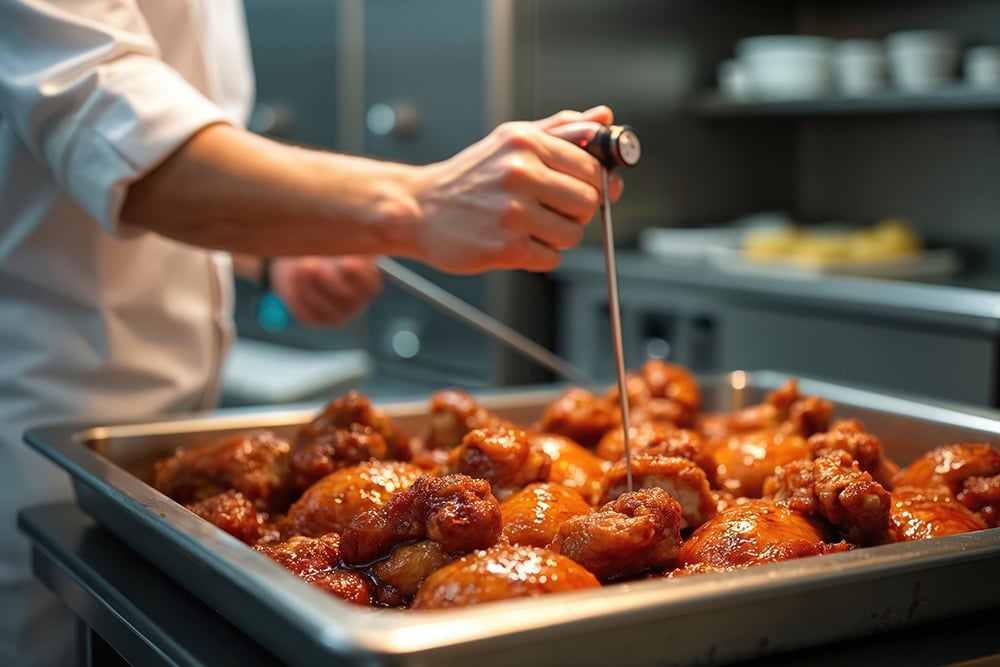
The best way to kill bacteria in food is to cook it thoroughly to a recommended core temperature, such as 70°C maintained for 2 minutes or 75°C for 30 seconds, using a clean probe thermometer to check the core.
Yes, thawed food contains the same bacteria that were present before freezing. Once the food defrosts, these bacteria become active again and multiply quickly if left in the danger zone.
Ensuring your entire team understands core temperature controls, cross-contamination risks, and hygiene best practices is the single best way to protect your customers and secure a 5-star Food Hygiene Rating. The Safer Food Group’s Level 2 Food Safety & Hygiene Course is City & Guilds Assured, CPD Accredited, and full of videos and interactive lessons, making compliance training quick, engaging, and accessible for any food handler.
👉 Enrol your staff or start your Level 2 Food Safety course today from just £14
Join 950,000+ learners
Explore our award winning online video based training

The Safer Food Group
Unit 2, Integrity House,
Lower Lumsdale, Matlock
DE4 5EX

Back
to top
© The Safer Food Group 2026 | Privacy policy