Search
Menu
The Safer Food Group
Unit 2, Integrity House,
Lower Lumsdale, Matlock
DE4 5EX
info@thesaferfoodgroup.com0800 612 6784

The 4 Stages of Cleaning: A Step-by-Step Guide for Food Businesses
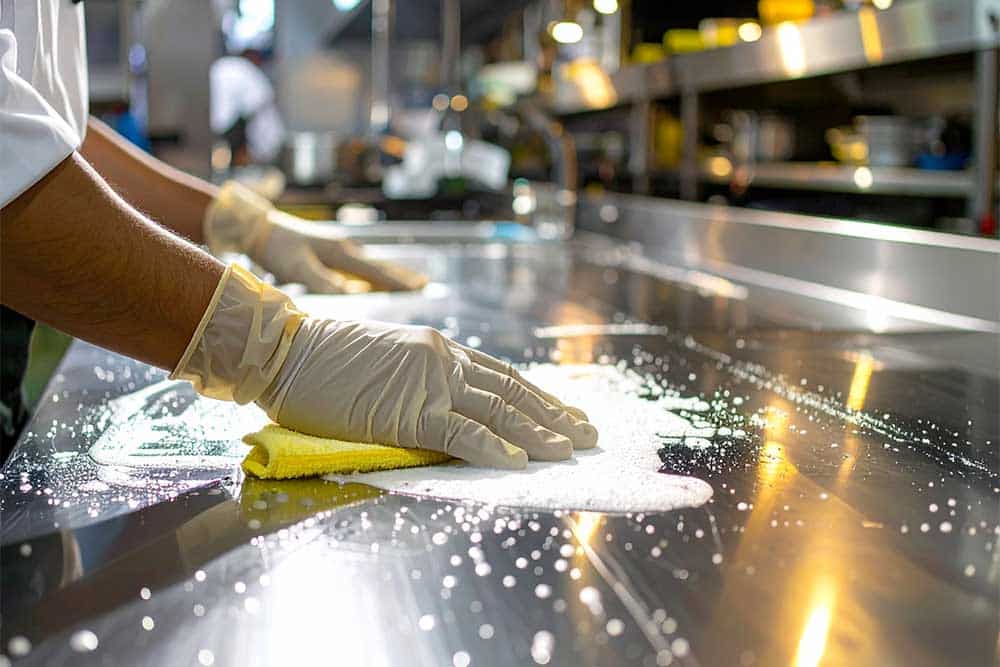
Handing wearing rubber glove cleaning stainless steel surface

In this article

In this article

In a busy kitchen, superficial cleaning isn't enough to pass an inspection or protect a customer. Ideally, all equipment, crockery and utensils should be cleaned in a commercial dishwasher, which reaches adequate temperatures to clean and disinfect thoroughly. In situations where this is not practical or possible, use a structured process that removes both visible dirt and invisible bacteria, commonly known as the 4-Stage Clean.

What are the four stages of cleaning utensils and equipment correctly?

1. Stage 1: Preparation 

The goal of the first stage is to remove the visible waste. If you skip this, your cleaning water will become dirty almost immediately, and your chemicals won't be able to reach the surface of the equipment.

  • The Action: Clear away loose food debris, crumbs, and excess grease.
  • The Method: Use a scraper, a disposable paper towel, or a stiff brush. For larger items, a quick rinse with warm water in separate sink may be necessary.
  • Pro-Tip: Always clean as you go. Removing food waste immediately prevents it from drying and hardening, which makes Stage 2 much easier and more effective.

2. Stage 2: Main Clean 

Now that the loose debris is gone, you need to tackle the grease and bio-films that stick to the surfaces of the utensils and equipment.

  • The Action: Use hot water and a high-quality detergent to break down grease and lift stubborn dirt.
  • The Method: Apply the water + detergent using a clean cloth, sponge, or brush. Use physical "elbow grease" to ensure all surfaces, including handles and hard-to-reach areas, are cleaned.
  • Critical Note: It is a common misconception that detergents kill bacteria. They do not. Their job is to clean, not to disinfect. You are essentially clearing the surface for the safety step that follows.

3. Stage 3: Disinfection 

This is the most critical stage to prevent food poisoning. Disinfection denatures or reduces pathogens such as E. coli or Salmonella to a level that is safe for humans.

  • The Action: Apply a chemical disinfectant to the clean surface.
  • The Standard: Ensure your chemicals meet BS EN 1276 or BS EN 13697 standards. This proves the product is tested and effective against common  pathogens found in food.
  • The Contact Time: This is where many businesses fail an audit. Chemicals do not kill bacteria instantly. You must check the label and allow the disinfectant to sit for the required contact time (often between 30 seconds and 5 minutes) before wiping.

4. Stage 4: Final Rinse and Drying

The final stage ensures the equipment is ready for use and won't contaminate the food with chemical residues.

  • The Action: Rinse away any remaining disinfectant with clean, hot water.
  • The Drying Method: Whenever possible, air-dry equipment. Using tea towels is highly discouraged by EHOs, as towels can quickly become bacterial sponges that move germs from one plate to the next.
  • Storage: Once dry, store the equipment in a designated clean area (such as a rack or enclosed cupboard) to prevent dust or pests from contaminating your hard work.

Common Cleaning Pitfalls

To maintain a 5-star rating, avoid these three frequent mistakes:

  1. Dirty Cloths: Using a cloth to clean multiple surfaces without washing it effectively spreads bacteria around the kitchen. Use disposable blue roll wherever possible.
  2. Wrong Dilution: Mixing too much water with your chemicals makes them ineffective. Always follow the manufacturer’s instructions.
  3. Contact time: Using a 2-in-1 sanitiser can save time, but follow the instructions to the letter - they are designed to offer you convenience but still fight pathogens effectively.

Ensure Your Team is Compliant

Understanding how to clean effectively is a key part of maintaining a safe kitchen, and a fundamental element of Level 2 Food Hygiene training. Ensuring your staff understand and implement good cleaning practices, and can explain them to an EHO is a great step towards a high "Confidence in Management" score in your next inspection.

To help maintain your cleaning routine, download a free cleaning schedule template from our Resources area.


About the author

Clare Grantham

Clare is one of our course and content writers, with a wealth of experience in both food safety and education. Early career experience in catering and hospitality (chiefly fish and chip shops!) led Clare to undertake various roles, supporting voluntary organisations to achieve safe processes and 5 star ratings within their catering operations. Alongside a postgraduate qualification in education, and a university staff development role, this experience has enabled Clare to develop quality learning materials and resources that address topics from the food handler and business owner’s perspective.

More posts

Join 950,000+ learners

Explore our award winning online video based training

  • Level 2
    Food Hygiene
    Certificate Training
    The essentials of food safety and is suitable for all workers who handle, prepare and serve food.
    Find out more
    £12
    + VAT
    Multi-buy discounts from £6 per course
    Food Hygiene 
    Rating Scheme
    How to get a 5 rating
    This free course unlocks invaluable insights into the food hygiene rating scheme, revealing the three key areas examined by an EHO.
    Find out more
  • Level 1
    Food Hygiene
    Certificate Training
    The essential principles of Food Safety; it is designed for workers who do not handle or prepare food, but who work in an environment where food is prepared, served or sold.
    Find out more
    £12
    + VAT
    Multi-buy discounts from £6 per course
    Level 3
    Food Hygiene
    Certificate Training
    This Level 3 course has been developed for those in a supervisory or management role in a food environment.
    Find out more
    £89
    + VAT
    Multi-buy discounts from £80 per course
  • Level 2
    Food Allergy Training
    This version of Level 2 Food Allergy course looks at allergenic ingredients, their effects on the human body, and how to minimise the risks caused by allergens.
    Find out more
    £12
    + VAT
    Multi-buy discounts from £6 per course
    Level 3
    Food Allergy Training
    This course provides leaders, managers, supervisors and chefs with the tools and skills to assess food allergen risk within their own work environment.
    Find out more
    £48
    + VAT
    Multi-buy discounts from £24 per course
  • Level 2
    Nutrition Training
    Developed alongside a PhD Nutritional Specialist, advisor and author, this course provides in-depth understanding of human nutrition.
    Find out more
    £12
    + VAT
    Multi-buy discounts from £6 per course
    Level 2
    HACCP Training
    A Food Safety Management System such as HACCP is a legal requirement in any commercial food production setting.
    Find out more
    £12
    + VAT
    Multi-buy discounts from £6 per course
Need any help?
Call 0800 612 6784
Sign up to our newsletter
[piotnetforms id=645]
crossmenu linkedin facebook pinterest youtube rss twitter instagram facebook-blank rss-blank linkedin-blank pinterest youtube twitter instagram