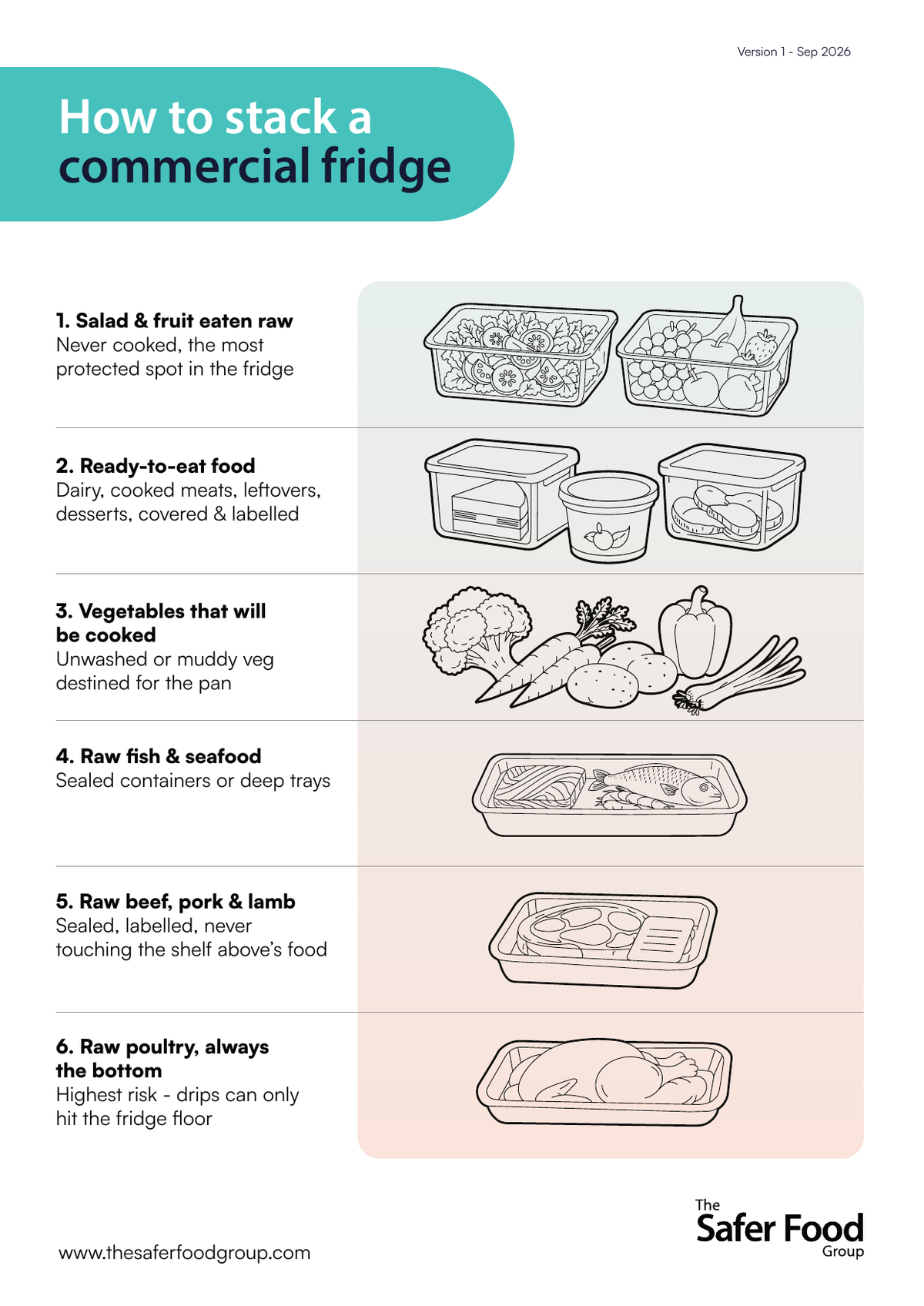
How to stack a commercial fridge — the shelf order that actually keeps food safe
A free printable poster and an interactive stacking activity for commercial kitchens. Salad and fruit at the very top, raw poultry at the very bottom — and an honest look at why the famous “salad drawer” is one of the worst places for salad.
At a glance
What it is
A printable A4 poster showing the correct top-to-bottom shelf order for a commercial fridge or chiller, paired with an on-page stacking activity to test your team.
Who it's for
Chefs, kitchen assistants and anyone who loads a fridge or walk-in chiller in a UK food business — and the managers who train them.
Why it helps
Puts the one rule that matters where everyone can see it: food that will not be cooked never sits below raw food.
Where to use it
On the fridge or chiller door, in the prep area, and in staff inductions — with the online activity as a two-minute knowledge check.
Search for a fridge storage chart online and most of the diagrams you find — including plenty aimed at professional kitchens — put the salad drawer at the bottom, underneath the raw meat. That layout is inherited from domestic fridges, and in a commercial kitchen it gets the logic exactly backwards. The rule that actually keeps people safe is simple: if a food will not be cooked before it is eaten, nothing raw may ever sit above it. Cooking is the kill step that destroys harmful bacteria; food that skips it has no safety net.
Work down the fridge in this order. Shelf one, at the very top: salad leaves, fruit and anything else served raw — these get the most protected position in the whole fridge because a drip of raw chicken juice onto a washed lettuce is never cooked away. Shelf two: ready-to-eat food such as dairy, cooked meats, cooled leftovers and desserts, covered and date-labelled. Shelf three: unwashed or muddy vegetables that are destined for the pan — cooking will deal with what soil brings in, but they still sit above raw meat. Then the raw zone, lowest in the fridge: raw fish and seafood, then raw beef, pork and lamb, and on the very bottom shelf raw poultry — the ingredient with the highest bacterial risk goes where its drips can only ever hit the fridge floor. The Food Standards Agency's guidance is the same principle in one line: store raw meat, poultry, fish and eggs below ready-to-eat food.
One thing worth being straight about, because it is the question the poster prompts most often: shelves one and two are both ready-to-eat, so the split between them is not a risk ranking. Neither may sit below raw food, and that is the part that matters. Salad and fruit take the top spot because they are usually the least protected items in the fridge — often loose or in open trays, and served with no further preparation at all — while dairy, cooked meats and desserts are normally covered and sealed. If your fridge works better with those two swapped, nothing unsafe has happened.
Why the order matters
Raw meat, poultry and fish carry bacteria such as Campylobacter, Salmonella and E. coli O157. In a fridge those bacteria do not stay put: juices drip, packaging leaks, and a splash you never see transfers them to whatever sits below. What happens next depends entirely on the receiving food. A drip onto potatoes that will be roasted is destroyed in the oven. The same drip onto a bowl of prepared fruit salad goes straight onto a plate, because salad and fruit are served without any cooking at all. That is why height in the fridge equals protection: the less a food will be cooked, the higher it must sit.
This is not just good practice; it is the basis of UK law and guidance. Food businesses must protect food against contamination under retained Regulation (EC) 852/2004, and the Food Standards Agency's guidance and Safer Food Better Business packs are explicit: keep raw and ready-to-eat foods separate, store raw meat, poultry, fish and eggs below ready-to-eat food, and where possible use separate fridges for raw and ready-to-eat items. Alongside the stacking order, keep chilled food at 8°C or below — the legal maximum in England, Wales and Northern Ireland — and set the fridge at 5°C or below so you stay safely under it in real-world use.
A word of honesty: a poster and a stacking activity are awareness and training aids. They make the safe layout visible and easy to teach, but they are not a food safety management system and they do not by themselves make your business compliant. Your HACCP-based procedures, your temperature records and your local authority's expectations still apply — check current Food Standards Agency guidance if in doubt.
The salad-drawer trap
Common misconception
“Salad goes in the salad drawer at the bottom of the fridge.” In a commercial fridge, that is the single most dangerous place for it.
The “salad drawer” is a domestic idea — a humidity-controlled crisper designed for a home fridge that holds no raw meat below shoulder height. Copy it into a commercial kitchen and you put the food least able to defend itself (it will never be cooked) directly underneath every raw ingredient in the fridge, exactly where drips end up. Many storage charts online, and even some training materials, repeat this layout unchallenged.
Use the bottom drawer for what its position is actually good for: raw meat and fish in sealed containers — the drawer walls help contain any leaks — or vegetables that will be cooked. If raw meat and cook-first vegetables must share that space, keep the meat sealed in leak-proof containers and physically apart from the veg; cooking is a safety net, not a licence to let raw juices touch other food. And keep salad and fruit where they belong: on the top shelf, above everything raw.
When you haven't got six shelves
Most kitchens the poster ends up in do not have a neat six-shelf upright. Undercounter fridges, two-shelf display units and crammed walk-ins are the norm, and staff quite reasonably ask what to do when the diagram doesn't match the fridge in front of them. The answer is that the six shelves are an illustration of one rule, not a requirement in themselves. Collapse the order as far as you need to, in this priority:
Ready-to-eat above raw. Always. This one never bends. If the fridge has two levels, everything ready to eat goes on top and everything raw goes underneath.
Raw poultry lowest of the raw items. If you can only make one distinction within the raw zone, make it this one.
Sealed containers close the gap. Where shelves run out, leak-proof lidded containers and deep trays do the work the shelf order was doing — nothing can drip if nothing can escape.
Two fridges beat clever stacking. If raw and ready-to-eat genuinely cannot be separated by height, a second fridge for raw items is the real fix, and an inspector will see it that way too.
A few items sit awkwardly whatever the fridge. Eggs in shell are raw and shells carry Salmonella, so treat them as a raw item and keep them below ready-to-eat food — not in the door tray above the cooked meats. Vacuum-packed and sous-vide raw fish or meat is still raw: the pack reduces the drip risk considerably, but it can be pierced, and an unopened pack is not a reason to move it up next to the salad. Defrosting meat is the highest-risk item in the fridge on any given day — it should be on the bottom, in a tray deep enough to hold everything that comes out of it.
Test yourself: stack the fridge
Reading the order is one thing; placing it under pressure is another. Drag each food group onto a shelf — or select a food, then select a shelf — then check your stacking. Shelves one and two are both safe homes for ready-to-eat food, so either order at the top counts.
Stack the fridge
Six food groups, six shelves. Where does each one go?
Chiller · 5°C
Waiting to go in
Keyboard: tab to a food and press Enter to pick it up, then tab to a shelf and press Enter to place it. Press Escape to put it down again.
A training aid, not an assessment — the layout follows FSA guidance to store raw meat, poultry and fish below ready-to-eat food.
Where to display the poster
Put the poster where the stacking decision is made — at the fridge door, not in a folder:
On or beside every fridge and chiller door — eye level, so it is seen in the second before a delivery gets shoved onto the nearest empty shelf.
In the goods-in and prep areas — where deliveries are broken down and decisions about what goes where are first made.
In the induction pack — give new starters the poster on day one and the stacking activity on this page as their two-minute knowledge check.
By the walk-in chiller — walk-ins hide their layout; a poster at the door keeps the shelf logic in mind even when the shelves are out of sight.
Laminate the copies near sinks and prep surfaces — fridge doors get wiped down, and a soggy poster teaches nothing.
How to get the most from it
Teach the rule, not just the order. Staff who understand “nothing uncooked below raw” can handle the foods the poster doesn't show; staff who memorise six shelves cannot.
Run the activity in team briefings. Two minutes on a phone or the kitchen tablet; get everyone to a clean six-out-of-six before service.
Audit the fridge against the poster weekly. The gap between the poster and the actual shelves is your training need, written in food.
Pair it with sealed containers and labels. The order controls drips; lids, deep trays and date labels control everything else.
Keep it current. FSA guidance evolves — re-check food.gov.uk from time to time and reprint if anything changes.
Frequently asked questions
What order should food go in a commercial fridge?
Top to bottom: salad and fruit that will be eaten raw on the top shelf; ready-to-eat food such as dairy, cooked meats, leftovers and desserts next; unwashed vegetables that will be cooked in the middle; then raw fish and seafood; then raw beef, pork and lamb; and raw poultry on the bottom shelf. The principle is that food which will not be cooked must always sit above raw food, so drips can never fall onto it.
Why does salad sit above ready-to-eat food if neither will be cooked?
Both are ready to eat, so neither may sit below raw food and the safety difference between the top two shelves is small. The order is a practical convention rather than a risk ranking: salad and fruit are usually the least protected items in the fridge, often stored loose or in open trays and served with no further preparation at all, so they take the highest and best-protected position. Ready-to-eat food such as dairy, cooked meats and desserts is generally covered and sealed. If your fridge works better the other way round, the rule that matters is unchanged — both stay above every raw ingredient.
Can salad or fruit be stored in the bottom drawer below raw meat?
No. Salad and fruit are usually served without any cooking, so bacteria that drip onto them from raw meat or fish above are never killed. In a commercial fridge the bottom drawer sits below the raw shelves, which makes it one of the worst places for salad. Use the bottom drawer for raw meat and fish in sealed containers, or for vegetables that will be cooked, and keep salad and fruit high up, above every raw ingredient.
Can raw meat share a drawer with vegetables?
Only with care, and only with vegetables that will definitely be cooked. Cooking kills the bacteria that matter, which is why vegetables destined for the pan may sit low in the fridge. Even so, keep raw meat and fish in sealed, leak-proof containers and physically apart from the vegetables — thorough cooking is a safety net, not a licence to let raw juices touch other food. Ideally, give raw meat and fish their own drawer or fridge.
What if my fridge is too small to separate everything?
Undercounter and two-shelf fridges are common in small kitchens, and the same rule still applies: ready-to-eat food goes above raw food, always. With only two levels, put everything ready to eat on the top shelf and everything raw on the bottom, with the raw items in sealed, leak-proof containers or deep trays. If you cannot keep raw and ready-to-eat food apart even that far, the safest answer is a second fridge for raw items — and your food safety management system should record how you manage the risk in the meantime.
Does displaying this resource make my business compliant?
No. The poster and activity are awareness and training aids that help your team stack the fridge safely, but they do not by themselves make your business compliant. You remain responsible for your food safety management system, your HACCP-based procedures and your local authority's expectations. Always check current Food Standards Agency guidance.
What temperature should a commercial fridge be?
In England, Wales and Northern Ireland it is a legal requirement to keep chilled food at 8°C or below, and the Food Standards Agency recommends setting fridges at 5°C or below so food stays safely under the legal limit even when the door is in use. Check and record fridge temperatures at least daily.
Ready to go further than a poster?
The poster shows the safe layout; training explains the “why” behind it — cross-contamination, temperature control and the system that decides your fridge rules in the first place. These two EHO-approved courses cover both.
Level 2 · All staff
Level 2 Food Hygiene
Essential food safety for anyone who handles food — including safe storage, temperature control and keeping raw and ready-to-eat food apart. Catering, retail, early years, manufacturing and schools versions.
Your fridge layout is a control in a bigger system. This course explains hazard analysis and critical control points — how a kitchen decides what could go wrong, and which checks stop it.
Free and print-ready. Stick it on every fridge and chiller door, run the stacking activity in your next team briefing, and make “nothing uncooked below raw” the house rule.
Free commercial fridge storage poster + a 2-minute stacking activity — the correct shelf order, and why salad never goes below raw meat (whatever the "salad drawer" says). No sign-up: https://www.thesaferfoodgroup.com/fridge-storage-poster.php
About the author
CG
Clare Grantham
Course & Content Writer
Clare is one of our course and content writers, with a wealth of experience in both food safety and education. Early career experience in catering and hospitality (chiefly fish and chip shops!) led Clare to undertake various roles, supporting voluntary organisations to achieve safe processes and 5 star ratings within their catering operations. Alongside a postgraduate qualification in education, and a university staff development role, this experience has enabled Clare to develop quality learning materials and resources that address topics from the food handler and business owner's perspective.