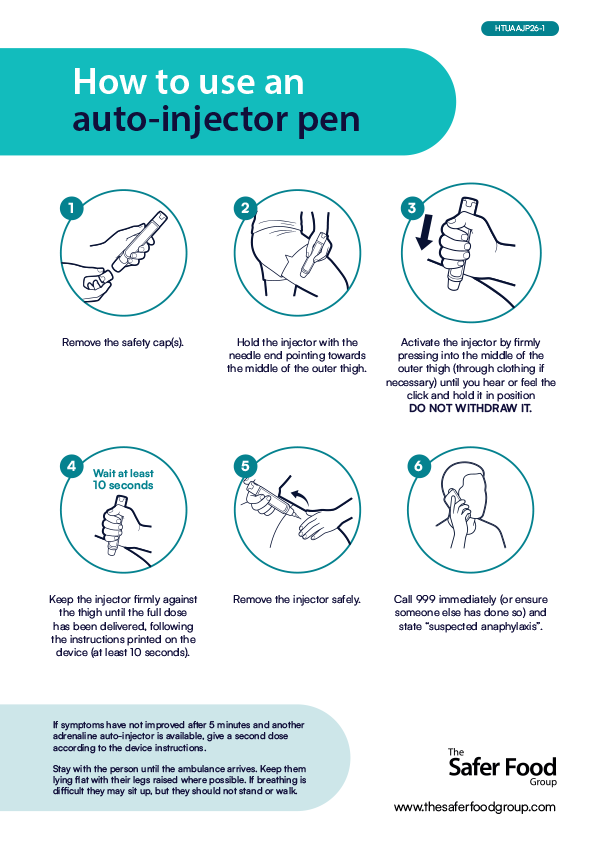
A calm, print-ready A4 poster of the general steps for using an adrenaline auto-injector in a suspected anaphylaxis emergency — for schools, nurseries, care settings and food businesses.
At a glance
What it is
A free A4 poster setting out the general steps for using an adrenaline auto-injector (AAI) when someone is having a suspected anaphylactic reaction.
Who it's for
Schools, nurseries and early years settings, care and healthcare settings, catering kitchens and food businesses - anyone responsible for people at risk of severe allergic reactions.
Why it helps
It puts clear, calm steps where staff can see them, so the right action happens quickly in the seconds that matter, and reinforces allergen training.
Where to use it
Staff rooms, kitchens, medical and first-aid points, and alongside individual allergy or care plans.
This is a free, print-ready A4 poster that shows the general steps for using an adrenaline auto-injector (AAI). This is the device that many people at risk of severe allergic reactions carry, sold under brand names such as EpiPen, Jext and Emerade. It is designed to be displayed where staff can see it instantly, so that in an emergency situation there is a clear, calm reference on the wall.
The poster lays out five illustrated steps — remove the safety cap, position the needle end against the middle of the outer thigh, press firmly until it clicks and hold, keep it in place for at least 10 seconds until the full dose is delivered, then remove it safely. This is followed by the single most important prompt: call 999 immediately and tell them you have a suspected anaphylaxis. It also carries the essential reminder that different devices have slightly different instructions, so staff must always follow the instructions printed on the actual device being used.
Why it matters
Anaphylaxis is a severe, life-threatening allergic reaction that can develop within minutes. Adrenaline given early, into the outer thigh, is the first-line treatment, and medical advisors including the Resuscitation Council UK are clear that speed matters. A poster on the wall will not replace training, but it will reinforce learning and provide a visual prompt to help you do the right thing in the right order without hesitating in an emergency.
Settings that look after people at risk have clear responsibilities. Under the June 2026 statutory guidance made under the Children's Wellbeing and Schools Act 2026, schools in England must have an allergy safety policy, are expected to stock spare adrenaline devices, and must provide allergy awareness training to all staff at least annually — the guidance is explicit that "first aid training is not sufficient". Food businesses, meanwhile, adhere to specific food safety legislation, where communication and preventing a reaction in the first place is the priority. Both rely on the same thing: trained people who know what to do.
Be clear about what this poster is and isn't. It is an awareness and training aid — a prompt, not a protocol. It does not make a setting compliant on its own, does not replace individual allergy action plans, in-date devices or proper first-aid training, and it never overrides the instructions printed on the actual device. Treat it as one visible layer on top of good training and planning, not a shortcut around them.
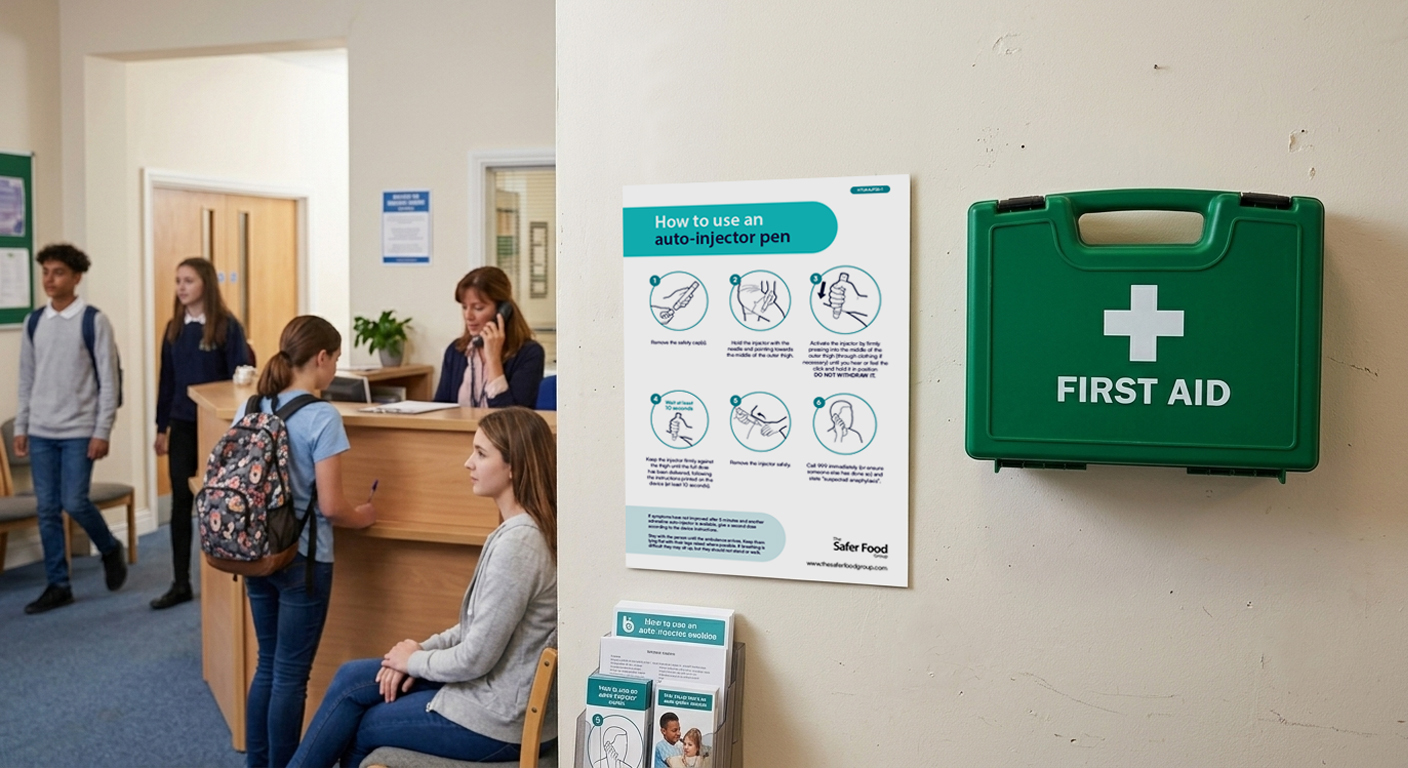
The poster works best displayed at a first-aid point or medical area, close to where devices and care plans are kept.
Is your setting ready for an anaphylaxis emergency?
Use this quick self-check to spot gaps in how prepared your setting is. It is a self-assessment aid to prompt discussion — not a formal audit, first-aid needs assessment or compliance record.
Being prepared
The things that should be in place before anything happens.
Knowing what to do
Whether staff could act confidently on the day.
Being prepared 0/8
Knowing what to do 0/8
0 of 16 in placeTick the boxes that are reliably true to see where you stand.
This is a self-assessment aid to spot gaps in your own practices, it is not a formal audit or compliance record.
Where to display it
The poster only helps if people can see it in the moment. Put it where staff already look and where devices are kept:
First-aid and medical points — next to the first-aid box and anywhere spare auto-injectors are stored.
Staff rooms and offices — so the whole team, not just first-aiders, has seen the steps.
Kitchens and food prep areas — where allergen risk is highest in catering and food businesses.
With individual care plans — inside allergy folders, class files or care records for at-risk individuals.
Wherever it goes, keep it beside the individual's own care plan and device instructions rather than as a stand-alone notice.
How to get the most from it
Print it in colour. The numbered steps and illustrations are easier to follow at a glance in colour.
Laminate it. A wipe-clean A4 copy survives kitchens, medical rooms and busy walls.
Size it up. Print larger than A4 for shared or high-traffic areas so it reads from a distance.
Pair it with training. Use it to reinforce, not replace proper first-aid and allergen training.
Keep it current. Check device instructions and current guidance periodically, and re-download if we update the poster.
Frequently asked questions
Which adrenaline auto-injectors does the poster cover?
The poster covers the adrenaline auto-injectors used in the UK, such as EpiPen, Jext and Emerade. Note that there are now two licensed types of adrenaline device — the auto-injector and a newer non-injectable nasal adrenaline device (nasal spray) — and this poster covers the auto-injector. Each device has slightly different operating instructions, so always read and follow the instructions printed on the actual device being used and any training you have received.
When should a second dose be given?
If symptoms have not improved after 5 minutes and a second adrenaline auto-injector is available, a second dose can be given according to the device instructions. Stay with the person until the ambulance arrives and keep them lying flat with their legs raised where possible; if breathing is difficult they may sit up, but they should not stand or walk.
Does displaying this poster make my setting compliant?
No. The poster is an awareness and training aid, not a substitute for proper first-aid training, individual care plans, in-date devices or a first-aid needs assessment.
Can schools use spare adrenaline auto-injectors without consent?
Schools in England have been able to hold spare auto-injectors since the Human Medicines (Amendment) Regulations 2017. Schools do not require consent to have been obtained for "spare" adrenaline devices to be used in an emergency. It is good practice for the school, college or setting to obtain advance consent from parents or the young person for "spare" adrenaline devices to be used, so that in an emergency, consent can be assumed to be in place. However, in an emergency situation anyone may take reasonable action to save a life without checking whether prior consent has been given, in order to avoid delays in treatment. Always follow current medical guidance and legislation and make sure named staff are trained.
Can I print and share the poster freely?
Yes. It is free to download, print and display in your setting. It works best printed in colour at A4 or larger and laminated, placed where staff can see it quickly in an emergency.
Ready to go further than a poster?
A poster prompts the right action in an emergency — but preventing reactions and knowing how to respond comes from training. These two allergen courses pair an entry level for all staff with an advanced level for the manager or supervisor responsible.
Level 2
Allergy Awareness Level 2
For food handlers, front-of-house, care and school staff who need to understand allergens and react appropriately. Choose the catering, early years or schools version.
Clare is one of our course and content writers, with a wealth of experience in both food safety and education. Early career experience in catering and hospitality (chiefly fish and chip shops!) led Clare to undertake various roles, supporting voluntary organisations to achieve safe processes and 5 star ratings within their catering operations. Alongside a postgraduate qualification in education, and a university staff development role, this experience has enabled Clare to develop quality learning materials and resources that address topics from the food handler and business owner's perspective.